
Quick Answer: The broadcast TV fee is a monthly charge that cable companies add to pay for carrying local channels like ABC, CBS, NBC and FOX. It is not a government fee. In 2026 Cox charges $32.00 a month, Xfinity’s amount depends on your market and plan, and DIRECTV satellite lists no broadcast TV fee at all.
Last checked October 13, 2026, against Cox’s 2026 surcharge sheet, Xfinity’s fees support article (updated August 31, 2026) and price-change page, DIRECTV’s satellite package page, DISH’s package terms and YouTube TV’s sign-up page.
Local stations are free over the air with an antenna. But a cable or satellite company has to pay each station for the right to carry it, a payment called a retransmission fee. Many providers pass that cost to you as its own line on the bill instead of putting it in the advertised package price.
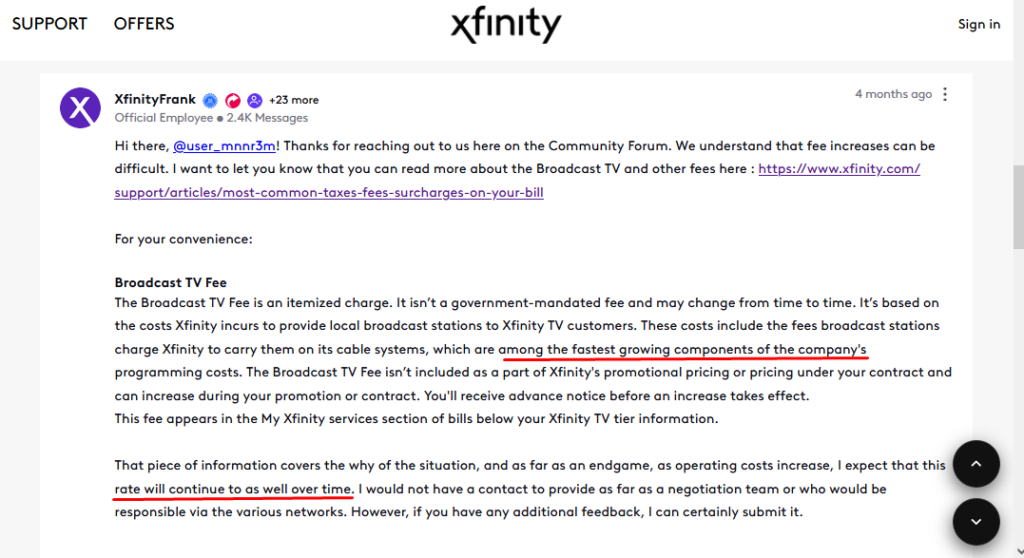
The fee is not set by the government. Xfinity’s own support article on bill fees says so plainly, and adds that the fee can change even during a promotion or contract, with notice. Providers chose this way of billing because it lets them advertise a lower package price.
How Much Is the Broadcast TV Fee?
It depends on your provider, and with cable it often depends on your city too. This table shows what each provider’s own pages said on October 13, 2026.
| Provider | Broadcast TV fee (2026) | What the provider says |
|---|---|---|
| Cox | $32.00 a month ($384 a year) | Called the Broadcast Surcharge. The same $32.00 in every market on Cox’s sheet, effective January 1, 2026. |
| Xfinity (Comcast) | Varies by market | Listed on Limited Basic and older plans. Xfinity says its new 2026 TV packages include the fee in the package price instead of listing it. |
| Spectrum | Varies by market | Called the Broadcast TV Surcharge. A Rochester Democrat and Chronicle report put it at $25.75 a month on New York bills, up from $23.20. We could not confirm a 2026 amount from Spectrum itself. |
| DIRECTV satellite | None listed | Local channels are included where available. Leaving them off saves $12 a month. DIRECTV does add a $10 TV Access Fee. |
| DISH | None listed for America’s Top 120 | DISH says local channels are part of the America’s Top 120 advertised price. |
Xfinity customers can find their own figure in the My Xfinity Services section of the bill. If you have Spectrum or another cable company, look for a line with “broadcast” in its name, or ask for the fee in writing before you sign up.
Why Does the Broadcast TV Fee Keep Going Up Every Year?
It goes up because local stations charge cable companies more each time their carriage deals renew. Stations argue that live local news and sports are worth more now that fewer people pay for cable. Providers push back, but they usually pay in the end, because losing ABC or CBS would cost them customers.
That cost then lands on your bill. Xfinity says the fee is not part of promotional or minimum-term pricing, so it can rise while your package price is locked. That is why some bills go up in the middle of a deal even though nothing in the package changed.
Which Providers Do Not Charge a Broadcast TV Fee?
Some providers do not list one, but you still pay for local channels somewhere in the price. The difference is only whether the cost sits inside the package price or on its own line.
DIRECTV satellite and DISH put local channels inside the package price for new customers. Xfinity’s new 2026 TV packages do the same. Live TV streaming services work this way too: YouTube TV’s sign-up page shows one price, $82.99 a month, with no broadcast fee listed.
Worth knowing: a fee folded into the price has not gone away. It just makes the advertised price look higher and the bill look simpler. Compare the full monthly total, not the line items.
What Is the Difference Between the Broadcast TV Fee and the Regional Sports Network Fee?
They often appear next to each other on the same bill, but they pay for different channels.
| Fee | What it pays for | Who usually pays it |
|---|---|---|
| Broadcast TV fee | Local stations such as ABC, CBS, NBC, FOX and CW | Most cable customers with local channels |
| Regional sports network fee | Regional sports networks, the channels that carry your local teams, such as NESN, YES Network or FanDuel Sports Network | Customers whose package includes those channels |
The regional sports network fee can be almost as large. On DIRECTV satellite it is up to $23.99 a month on the Choice package and higher. Cox’s 2026 sheet lists $22.00 in Orange County, so a Cox customer there pays $54.00 a month in these two fees before the TV package itself.
Can You Get Rid of the Broadcast TV Fee?
You cannot remove it and keep the same cable plan, but you can avoid it by changing how you get local channels.
- Use an antenna. It picks up local ABC, CBS, NBC, FOX and PBS stations for a one-time cost and no monthly fee. If you do not want an antenna, our guide on watching local channels without an antenna covers the other routes, and there is also a video on the TVProz YouTube channel.
- Drop the local channels from a satellite plan. DIRECTV says leaving them off saves $12 a month, which makes sense if an antenna already gets your stations.
- Switch to a live TV streaming service. These quote one price with local channels included. Check the full price, because some cost more than a basic cable plan with the fee.
- Call your provider’s retention team. Ask what offers they have. Providers would often rather lower your bill a little than lose you.
If you only want free channels, our guide to watching live TV for free lists the options that cost nothing each month.
Is the Broadcast TV Fee Going Away?
No, but it is getting harder to hide. The FCC’s all-in pricing rule requires cable and satellite companies to show one total price for TV programming, including broadcast and sports fees, in their ads and on bills. Large companies had to comply by December 19, 2024 and smaller ones by March 19, 2025, according to U.S. PIRG.
Taxes, equipment charges and administrative fees can still be listed on their own. So the most useful check is still the same: before you sign up, ask for the total monthly price with every fee included, and the price after any promotion ends.

The author specializes in U.S. cable, satellite, and streaming TV services, with hands-on experience analyzing channel lineups, regional restrictions, equipment requirements, and contract terms. All the content is written with clear, easy-to-understand explanations to help readers compare services accurately and make informed decisions.
8 thoughts on “Broadcast TV Fee: What It Is and What Each Provider Charges”